

















America’s 250th Anniversary: Meaningful Ways Homeschool Families Can Celebrate Independence Day
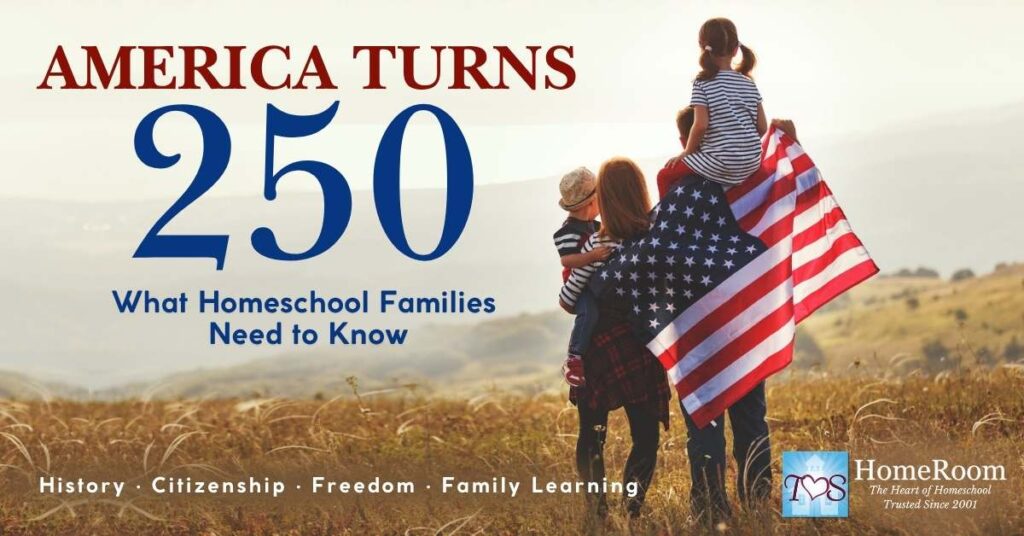
Independence Day is more than fireworks and cookouts. As we approach America’s 250th anniversary, homeschool families have a unique opportunity to connect history with real-life learning.
At SchoolhouseTeachers.com, we have been celebrating the countdown with our 250-Day Challenge. Starting Oct. 28, 2025, we have been inviting families to join us on a journey through faith-filled stories that shaped America’s independence.
On July 4, 2026, Americans have the opportunity to celebrate the 250th anniversary of our nation. This is a wonderful celebration and accomplishment for our nation founded on the simple truths of life, liberty, and the pursuit of happiness. For over 250 years, America has kept the flame alive of the Founding Fathers. Though there have been dark times in our history, we are still blessed with the freedom to worship, homeschool, and live our lives as citizens.
Why America’s 250th Anniversary Matters
You may hear America’s 250th anniversary referred to as the Semiquincentennial, a term used to describe a 250-year anniversary. While the word may be a mouthful, the occasion is significant. In 2026, the United States will celebrate 250 years since the Declaration of Independence was adopted on July 4, 1776, making it a fitting time to explore the people, events, and ideals that helped shape our nation.
While many nations are older than the United States, relatively few have maintained the same governing framework for as long as America has. As the nation celebrates 250 years of independence, it joins a small group of countries whose political institutions have endured for centuries while continuing to adapt to changing times. (See chart at end of article.)
The United States is somewhat unique because:
- it has maintained the same Constitution since 1789, albeit with amendments;
- it has remained a republic throughout its existence; and
- power has changed hands peacefully through elections for most of its history.
What also makes the United States of America unique is that the majority of long-established nations are constitutional monarchies. Some examples include the United Kingdom, Sweden, Denmark, Spain, and Japan.
And other nations that are older than the United States have changed with absolute monarchies becoming constitutional monarchies, monarchies becoming republics, and republics becoming dictatorships and later democracies—not to mention there are those nations that were conquered, dissolved, or reconstituted under new governments. France is a classic example. Since the American Revolution, France has been a monarchy, republic, empire, monarchy again, and republic multiple times before arriving at its current Fifth Republic in 1958.
Understanding the Road to Independence
- Key events leading to July 4, 1776
- The Declaration of Independence
- The sacrifices made to secure liberty
Teaching Freedom and Responsibility
As America celebrates 250 years of independence, it is also an opportunity to reflect on the responsibilities that accompany freedom. Understanding citizenship is an important part of helping children appreciate the rights and privileges they enjoy today. Homeschool families can use this historic milestone to discuss what it means to be a good citizen, how communities function, and why civic responsibility matters. These conversations help children connect the events of the past with the role they play in their families, churches, communities, and nation.
SchoolhouseTeachers.com offers age-appropriate citizenship courses that help students build a strong foundation in civic understanding. Teaching homeschool history is easy when you see the many history-themed and citizenship-themed courses offered by SchoolhouseTeachers.com. Younger learners can begin with Exploring Citizenship in First Grade and Growing in Citizenship in Second Grade, while older elementary students can deepen their knowledge through Rights of Citizens for Third Graders and Rights of Citizens for Fourth Graders. These courses provide practical lessons on citizenship, responsibility, and civic engagement, making them a valuable complement to any study of America’s 250th anniversary. By learning about both the freedoms and responsibilities of citizenship, students can gain a greater appreciation for the principles that have shaped the United States for the past two-and-a-half centuries.
Ways Homeschool Families Can Celebrate
Have you been celebrating America’s 250th anniversary all year? Or do you need to find last-minute homeschool history activities and ideas? Many companies have provided excellent resources to help you and your children learn more about 1776, the Founding Fathers, the American Revolution, and the Declaration of Independence. And you can continue studying about the 250th anniversary even after July 4. There is no time limit on learning history.
Here are some ideas to help you get started:
- Read founding documents together
- Create a 250-Year Timeline
- Study Revolutionary War figures
- Host a Colonial-Themed Day
- Visit historical sites or museums
- Complete a patriotic unit study
- Memorize a portion of the Declaration of Independence
- Read living books and biographies
- Read historical fiction
- Complete hands-on projects like those offered by Home School in the Woods
Looking Forward: What Will the Next 250 Years Hold?
As we reflect on America’s first 250 years, it is natural to wonder what the next 250 years might bring. While no one can predict the future, homeschool families have a unique opportunity to help shape it by investing in the next generation. The children learning around our kitchen tables today will become tomorrow’s leaders, business owners, pastors, community, and parents. Teaching them about history is about more than memorizing dates and events. It is about helping them understand the principles, sacrifices, and responsibilities that have shaped our nation.
One of the most valuable lessons we can pass on is the importance of informed citizenship. Children who understand their nation’s history are better equipped to participate thoughtfully in their communities and make wise decisions as adults. Alongside civic knowledge, we can encourage character, stewardship, and service. Honesty, integrity, compassion, responsibility, and a willingness to serve others are qualities that strengthen families, communities, and nations. As homeschool parents, we have the privilege of cultivating these values while preparing our children to become faithful stewards of the freedoms they have inherited.
Conclusion
America’s 250th anniversary is a milestone worth celebrating. It provides an opportunity to pause and reflect on the people, events, and principles that have shaped our nation over the past two-and-a-half centuries. While Independence Day is often marked by fireworks, parades, and family gatherings, it can also serve as a meaningful reminder of the blessings and responsibilities that accompany freedom.
As you celebrate this historic anniversary with your family, consider using the occasion as a springboard for deeper learning. Explore the stories of the founding generation, study the Declaration of Independence, discuss the responsibilities of citizenship, and discover how history continues to influence our lives today. Whether your family spends a few days or an entire school year exploring America’s story, the lessons learned will extend far beyond July 4th. The study of history helps us understand where we have been, appreciate the freedoms we enjoy today, and prepare wisely for the future.

Countries Older Than 250 Years
Examples include:
| Country | Approximate Age as a Sovereign State | Current Government |
| San Marino | Since AD 301 | Constitutional republic |
| United Kingdom | Since 927 | Constitutional monarchy |
| Portugal | Since 1143 | Parliamentary republic |
| Switzerland | Since 1291 | Federal republic |
| Spain | Since 1479 | Constitutional monarchy |
| Netherlands | Since 1581 | Constitutional monarchy |
| United States | Since 1776 | Constitutional federal republic |
| Sweden | Since the 10th century | Constitutional monarchy |
| Japan | Ancient state origins | Constitutional monarchy |
| Denmark | Since the 10th century | Constitutional monarchy |
Guest Author
This article has been written by Kristen Heider. She is the Director of Marketing for The Old Schoolhouse®. She shares more about her family’s homeschooling journey at A Mom’s Quest Teach.
Don't Miss These!
-
 Read more +
December 11, 2025 By Lisa in * Holidays
How do I Keep My Homeschool Organized During the Holidays?
-
 Read more +
January 13, 2023 By Barbori in * Holidays, Blog
New Year, Fresh Start
-
 Read more +
January 4, 2023 By Barbori in * Holidays, Blog
Conquering Post-Holiday Homeschool Burnout
From Our Sponsors


























"Train up a child in the way he should go and when he is old, he will not depart from it" (Proverbs 22:6).
